There are moments in life that permanently change how you see everything else.
Sometimes it’s standing at the edge of the ocean for the first time, realizing how vast the world really is. Sometimes it’s looking up at the night sky and taking in its expanse, realizing it is not empty, but alive with depth and distance beyond comprehension. Sometimes it’s walking into a quiet hospital room and suddenly understanding how fragile life truly is.
You leave those moments the same person physically, but internally, something has shifted. Your perspective has expanded. Reality feels larger than it did before.
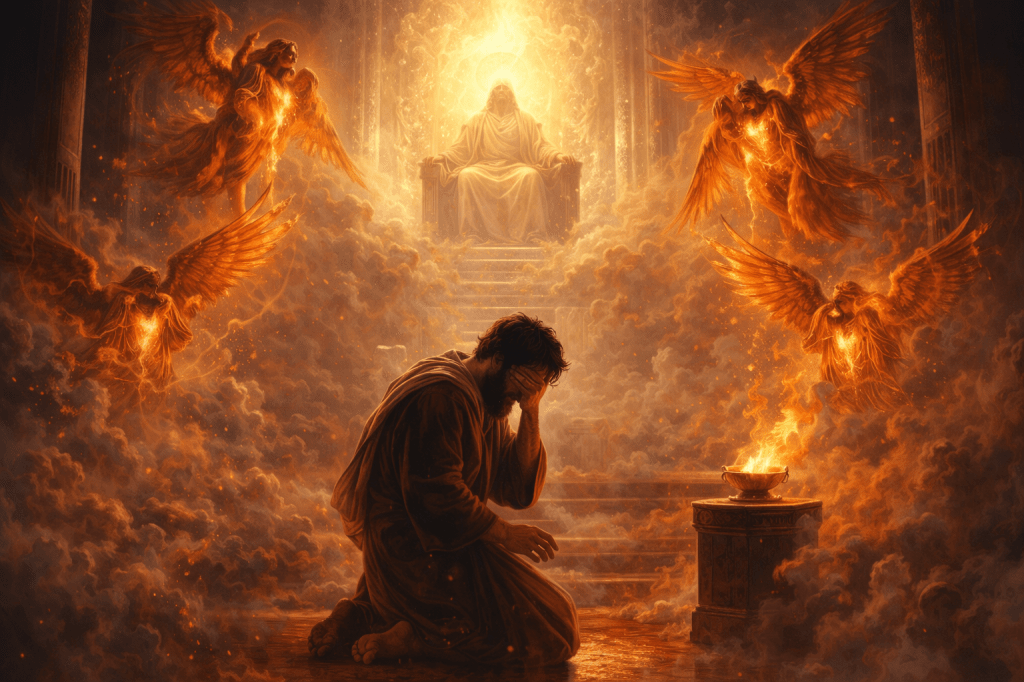
Scripture describes a moment like this in the life of the prophet Isaiah—a moment that did not just change how he saw the world, but how he saw himself, his sin, and his purpose. It is one of the most powerful and revealing encounters with God recorded anywhere in the Bible.
It begins with a simple statement: “In the year that King Uzziah died, I saw the Lord.”
At first glance, that historical detail may seem insignificant. But it sets the stage for everything that follows. King Uzziah had ruled for roughly four decades. His reign had brought stability, strength, and prosperity. He represented continuity. Predictability. Security. But now he was gone. The earthly throne was empty. The future was uncertain.
And it was precisely in that moment of uncertainty that Isaiah saw something greater.
He saw that while an earthly king had died, the true King was still seated on His throne.
This is where seeing with open eyes begins—not by seeing something new for the first time, but by seeing what has always been true. God was not absent. He was not weakened. He was not reacting to events. He was reigning, just as He always had been.
Isaiah describes the Lord as “high and lifted up,” seated on a throne, with the train of His robe filling the temple. The imagery is intentional. Everything about the vision communicates authority, majesty, and supremacy. God is not presented as one powerful being among many. He is presented as utterly unrivaled. His presence fills the space completely. There is no room for anything that competes with Him.
Surrounding the throne are seraphim—angelic beings whose very posture communicates reverence. They cover their faces. They cover their feet. They call out to one another continuously: “Holy, holy, holy is the LORD of hosts; the whole earth is full of His glory.”
The repetition is not accidental. In Hebrew expression, repetition intensifies meaning. To say that God is holy once is to affirm His purity. To say it twice is to emphasize it. But to say it three times is to elevate it beyond comparison. It is to declare that God is not merely holy—He is holiness itself. He exists in a category entirely separate from everything else.
This is the first effect of opened eyes: you begin to see God as He truly is.
Not as a projection of your preferences. Not as a distant spiritual concept. Not as a supporting character in your personal story. But as the central reality of all existence.
And when that happens, something else happens immediately.
You begin to see yourself clearly.
Isaiah’s response to this vision is not confidence or excitement. It is collapse. He cries out, “Woe is me, for I am ruined! Because I am a man of unclean lips and live among a people of unclean lips, and because my eyes have seen the King, the LORD of hosts.”
This is not exaggerated emotion. It is clarity.
Before this moment, Isaiah was already a religious man. He was already a prophet. He was already someone who spoke about God to others. But now, standing in the direct awareness of God’s holiness, he sees himself differently. He sees the depth of his own imperfection. He recognizes the gap between who God is and who he is.
Opened eyes do not merely reveal God’s greatness. They reveal our need.
This is deeply uncomfortable, and it is one of the reasons many people resist true openness to God. As long as God remains distant, we can maintain a favorable view of ourselves. We can compare ourselves to others and feel adequate. We can measure ourselves by human standards and feel secure.
But when we see God clearly, those comparisons disappear. We are no longer measuring ourselves against one another. We are measuring ourselves against holiness itself.
And in that light, illusion gives way to truth.
But the story does not end with Isaiah’s realization of his sin. In fact, this is where the most important part begins.
One of the seraphim takes a burning coal from the altar and touches Isaiah’s lips, saying, “Your guilt is taken away, and your sin is atoned for.”
This moment reveals something essential about God’s character. The same holiness that exposes sin also provides cleansing from that sin. God does not reveal our need in order to condemn us without hope. He reveals our need in order to meet it.
The altar was the place of sacrifice—the place where atonement was made. The coal represents purification, forgiveness, and restoration. Isaiah does not cleanse himself. He is cleansed by God.
This is the pattern seen throughout Scripture and fulfilled ultimately in Jesus Christ. God does not merely expose human brokenness. He acts to heal it. He does not merely reveal guilt. He provides grace.
Opened eyes lead not only to conviction, but to restoration.
And restoration always leads to purpose.
Immediately after Isaiah is cleansed, he hears the voice of the Lord saying, “Whom shall I send? And who will go for us?”
This question is not asked because God lacks knowledge. It is asked as an invitation. And Isaiah, who moments earlier believed himself ruined, now responds without hesitation: “Here I am. Send me.”
This is the final effect of open eyes. You begin to see your life not merely as something to preserve, but as something to offer.
Isaiah does not negotiate. He does not ask for details. He does not request guarantees of comfort or success. He responds with willingness.
Because when you truly see God—His holiness, His authority, His grace—it changes how you see everything else. The priorities that once dominated your thinking lose their power. The fears that once held you back lose their grip. The purpose you were created for begins to come into focus.
Opened eyes reorder your life.
They move you from self-centered living to God-centered living.
They move you from control to trust.
They move you from hesitation to availability.
This is not because of guilt or pressure. It is because you are now seeing the character God more clearly.
You cannot see God clearly and remain unchanged.
The truth is, God is no less real today than He was in Isaiah’s vision. He is no less holy. No less sovereign. No less present. The difference is not in God’s willingness to be seen, but in our willingness and ability to see.
Many people move through life with their eyes fixed entirely on what is temporary—careers, achievements, possessions, approval. These things feel urgent. They feel ultimate. But they are not. They shift constantly. They fade quickly. They cannot bear the weight of ultimate meaning.
Opened eyes allow you to see beyond what is temporary to what is eternal.
They allow you to see God not as an accessory to your life, but as its foundation.
They allow you to see yourself not as self-created, but as known, called, and loved by the One who made you.
And they allow you to see your life not as random, but as purposeful.
This kind of sight does not come through intelligence alone. It comes through openness. It comes through willingness. It comes through the courage to allow God to reveal what is true, even when that truth reshapes how you see yourself.
Because opened eyes are not just about seeing God.
They are about seeing everything else in light of Him.
 Jacob Orr
Leave a comment