There is a quiet assumption many of us live in without ever consciously choosing it: that churches are competing with one another.
Competing for attendance.
Competing for influence.
Competing for volunteers, visibility, and impact.
We may never say it out loud, but it shows up in subtle ways—how guarded we can be, how rarely we celebrate another church’s win, and how easily we default to “our church” instead of “Christ’s church.”
But Scripture—and lived experience—tells a very different story.
Over the past few years, the partnership between Bennettsville Second Baptist Church, where I serve, and Thomas Memorial Baptist Church, another local congregation, has reminded me of something both ancient and deeply needed: the church was never meant to operate alone.
The Myth of Church Competition
The New Testament knows nothing of churches competing for territory or prestige. What it does show us is churches cooperating for mission.
Paul didn’t plant churches and then pit them against one another. He connected them. He spoke of congregations supporting one another financially (Romans 15:26), rejoicing in one another’s faith (2 Corinthians 8), and functioning as one body with many parts (1 Corinthians 12:12–27).
Competition assumes scarcity:
- Not enough people
- Not enough resources
- Not enough influence to go around
The gospel assumes abundance:
- One Lord
- One mission
- One Spirit empowering all of us (Ephesians 4:4–6)
When churches compete, the community notices.
When churches partner, the community believes.
A Living Example: SBC & TMBC
The partnership between Bennettsville Second Baptist Church and Thomas Memorial Baptist Church did not begin as a branding strategy or a survival tactic. It grew out of shared values, shared trust, and a shared desire to see our community reached more effectively together than we ever could apart.
Their pastor, Josh, and I connected and quickly saw that we both wanted the same thing for our city. We were like-minded and serving the same community, so we decided to put our resources, financial, tangible, and human, together to serve it. They had some resources we were lacking, and vice versa. The motive was both spiritual and logical.
There was no ego or ulterior motive to this move, just a heart for God’s kingdom.
We started with just a couple of joint outreach efforts a year. Very quickly, partnership stopped being theoretical and became visible.
Now every week, leaders and volunteers from both congregations serve together in a Good News Club at a local school, proclaiming the gospel to children who may never otherwise hear it. No one asks which church gets the credit. The only question that matters is whether kids are encountering Jesus.
That posture has become a defining mark of our relationship.
Ministry That Becomes Tangible
When churches truly partner, the fruit shows up where people can see it.
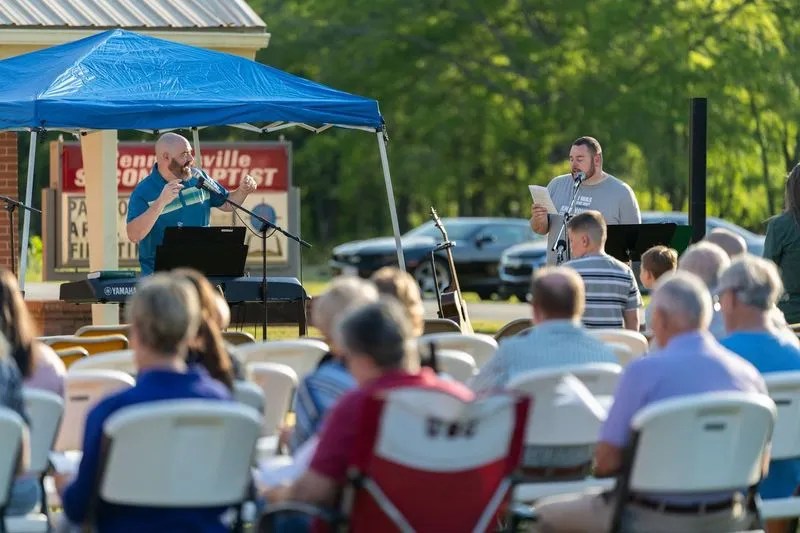
We’ve experienced that through community worship nights, where musical gifts and teaching voices from both congregations come together. Different styles, different leaders, one gathered church—lifting one voice in praise and sitting under the same Word. Those nights have done more than fill a room; they’ve reminded us that worship is bigger than any single platform.
And our people notice the difference. They love coming together for these nights. The atmosphere changes and fellowship deepens. The only criticism I have received about them is this: “We need to do this more often!”
Our joint student ministry has become another powerful picture of unity. Students aren’t separated by church labels; they’re discipled together, encouraged together, and challenged together to follow Christ. They see cooperation modeled by adults and grow up assuming that partnership—not competition—is normal in the body of Christ.
And beyond our walls, we’ve partnered in local outreach efforts alongside the city, showing up together to serve our neighbors in practical, visible ways. When the church stands united, the community doesn’t have to wonder whether we care—they can see it.
Personal Lessons From Partnership
Partnership reshapes a pastor’s heart.
It humbles you—because you’re no longer the sole voice or visionary.
It strengthens you—because you’re surrounded by leaders with different gifts.
It clarifies the mission—because the focus shifts from branding to obedience.
One of the most freeing realizations I’ve had is this: the success of another faithful church is not a threat—it’s evidence that the gospel is working.
When Thomas Memorial Baptist Church thrives, Bennettsville Second Baptist Church doesn’t lose. When we grow, TMBC doesn’t shrink.
The kingdom advances—and that’s the only scoreboard that matters.
A Biblical Vision for Partnership
Jesus prayed for this kind of unity.
“I pray not only for these, but also for those who believe in me through their word. May they all be one, as you, Father, are in me and I am in you… so that the world may believe you sent me.”
(John 17:20–21, CSB)
Unity is not merely internal harmony—it is missional credibility. Jesus ties our oneness directly to the world’s ability to believe.
Paul echoes this when he calls believers “God’s coworkers” (1 Corinthians 3:9). Not competitors. Coworkers.
When churches partner across campuses, neighborhoods, and traditions, we offer our community a visible picture of a gospel that reconciles rather than rivals.
A Word to Church Leaders
If you lead or serve in a church, here is a question worth sitting with:
Are we more committed to protecting our lane—or to advancing the gospel?
Partnership doesn’t mean losing identity.It means submitting identity to something greater.
It doesn’t erase distinctions.It redeems them for shared mission.
From the Other Side of the Partnership
This post is only part of the story.
Pastor Josh Hilton of Thomas Memorial Baptist Church has written a follow-up post next week sharing this partnership from his perspective—what it has meant for his congregation, his leadership, and his understanding of gospel cooperation.
I hope you’ll read his words with the same openness this partnership has cultivated in me.
Because if the church is going to meet this moment, we won’t do it by out-competing one another.We’ll do it by standing shoulder to shoulder—better together.
 Jacob Orr
Leave a comment