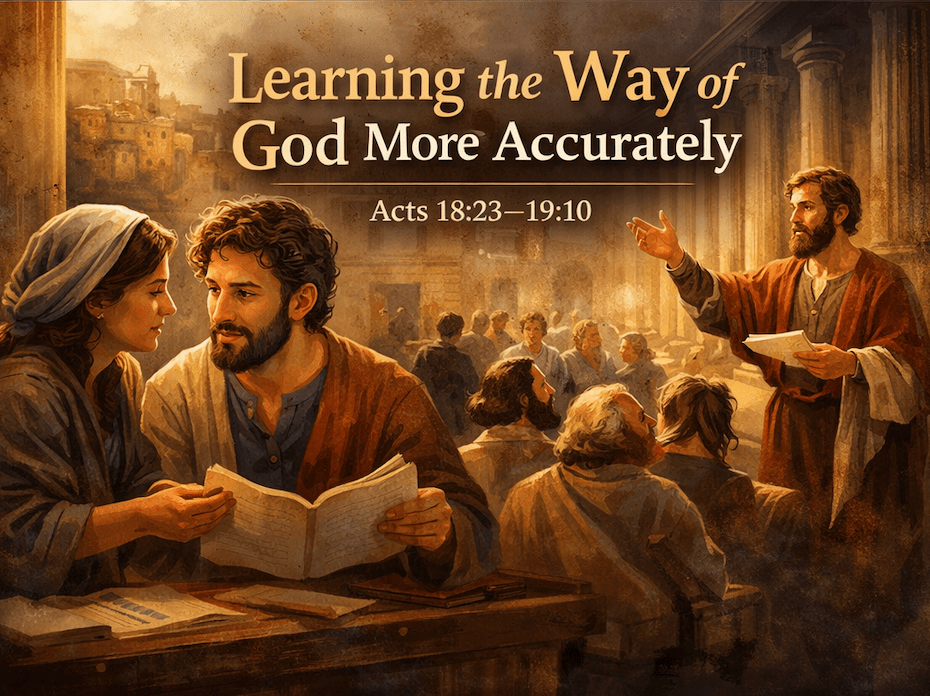
Acts 18:23–19:10 (CSB)
Last week, we talked about the danger of a spoon-fed faith—a version of Christianity that consumes spiritual truth without ever engaging it. Comforting? Yes. Formative? Not usually.
Scripture does not call us merely to be informed believers, but transformed ones. And transformation requires accuracy. Depth. Literacy.
Acts 18–19 gives us a living picture of what happens when sincere faith grows into accurate understanding—and what’s at stake when it doesn’t.
Sincere Faith Can Still Be Incomplete
Acts introduces us to a man named Apollos:
“Now a Jew named Apollos, a native Alexandrian, an eloquent man who was competent in the use of the Scriptures, arrived in Ephesus. He had been instructed in the way of the Lord; and being fervent in spirit, he was speaking and teaching accurately about Jesus, although he knew only John’s baptism.”
(Acts 18:24–25, CSB)
Apollos checks all the boxes we usually associate with spiritual maturity. He’s articulate. Passionate. Biblically trained. He speaks boldly and accurately—as far as his knowledge goes.
But Luke tells us something crucial: Apollos’ understanding, while sincere, is incomplete. He knows about repentance. He knows about preparation. But he does not yet grasp the fullness of the Gospel.
This is an important warning for the modern church. Passion does not automatically equal precision. Sincerity does not guarantee completeness. You can be gifted, active, and even effective—while still missing essential truths.
Biblical literacy is not about knowing more facts than others. It’s about knowing the right things accurately—and allowing those truths to shape our lives.
Biblical Literacy Grows Best in Humble Community
When Priscilla and Aquila hear Apollos teach, they recognize both his strength and his limitation.
“He began to speak boldly in the synagogue. After Priscilla and Aquila heard him, they took him aside and explained the way of God to him more accurately.”
(Acts 18:26, CSB)
Notice what they don’t do. They don’t correct him publicly. They don’t embarrass him. They don’t dismiss his ministry. Instead, they invite him into deeper understanding.
This is discipleship at its best: relational, patient, and grounded in love.
Priscilla and Aquila were not apostles. They weren’t the public faces of the movement. They were faithful believers who had themselves been taught well—and were willing to pass that teaching on.
Biblical literacy flourishes in environments where humility is valued over image, and truth is pursued over ego.
I’m reminded of my wife’s grandfather, a layman and long-serving deacon in a small country church. He listened carefully to sermons, took notes, and read through the Bible twice every year. On the rare occasion a pastor taught something inaccurately, he didn’t cause a scene. He would pull the pastor aside privately, open the Scriptures, and gently help him see the text more clearly.
That’s what Aquila looks like today. That’s what Priscilla looks like today. And that kind of quiet faithfulness shapes churches far more than we realize.
Accuracy Multiplies Impact
After receiving more accurate instruction, Apollos doesn’t retreat—he advances.
“When he wanted to cross over to Achaia, the brothers and sisters wrote to the disciples to welcome him. After he arrived, he was a great help to those who by grace had believed. For he vigorously refuted the Jews in public, demonstrating through the Scriptures that Jesus is the Messiah.”
(Acts 18:27–28, CSB)
Apollos’ ministry becomes sharper, stronger, and more effective—not because his passion increased, but because his understanding did.
Biblical literacy does not dampen zeal. It directs it.
When truth is handled accurately, it builds up believers and strengthens witness. The Scriptures become not just familiar words, but powerful tools in God’s hands.
Incomplete Teaching Produces Incomplete Living
While Apollos is ministering in Corinth, Paul arrives in Ephesus and encounters another group of disciples.
“He found some disciples and asked them, ‘Did you receive the Holy Spirit when you believed?’
‘No,’ they told him, ‘we haven’t even heard that there is a Holy Spirit.’”
(Acts 19:1–2, CSB)
These men are sincere. They are called disciples. They have responded to what they were taught.
And yet, they are missing something essential.
They had received John’s baptism—a baptism of repentance—but had not yet been taught about faith in Jesus and the gift of the Holy Spirit.
“Paul said, ‘John baptized with a baptism of repentance, telling the people that they should believe in the one who would come after him, that is, in Jesus.’
When they heard this, they were baptized into the name of the Lord Jesus.”
(Acts 19:4–5, CSB)
The result is transformation and empowerment:
“And when Paul had laid his hands on them, the Holy Spirit came on them, and they began to speak in tongues and to prophesy.”
(Acts 19:6, CSB)
The lesson is clear: incomplete teaching limits spiritual experience and effectiveness. These disciples were not rebellious—they were uninformed. They didn’t know what they didn’t know.
That’s why biblical literacy matters so deeply. You cannot live in the fullness of what you have never been taught.
Deep Learning Fuels Wide Impact
Paul continues his ministry in Ephesus, but when opposition arises, he adapts.
“Paul entered the synagogue and spoke boldly over a period of three months, arguing and persuading them about the kingdom of God. But when some became hardened and would not believe… he withdrew from them, taking the disciples, and conducted discussions every day in the lecture hall of Tyrannus.”
(Acts 19:8–9, CSB)
Paul doesn’t stop teaching. He changes locations.
For two years, he teaches daily—patiently, consistently, thoroughly.
“This went on for two years, so that all the residents of Asia, both Jews and Greeks, heard the word of the Lord.”
(Acts 19:10, CSB)
Notice the pattern: deep instruction leads to wide influence.
The Gospel spreads farthest where it is taught deepest.
Going Deeper—and Being Changed
Biblical literacy is not about intellectual pride. It is about spiritual maturity. It is about loving God with our minds as well as our hearts.
Like Apollos, we may be sincere but incomplete. Like the disciples in Ephesus, we may be faithful but under-taught. And like Priscilla, Aquila, and Paul, we are called to both learn and teach more accurately.
The invitation of Scripture is not to “get by,” but to grow.
Let’s go deeper in the Word of God—and be changed by it.
 Jacob Orr
Leave a comment