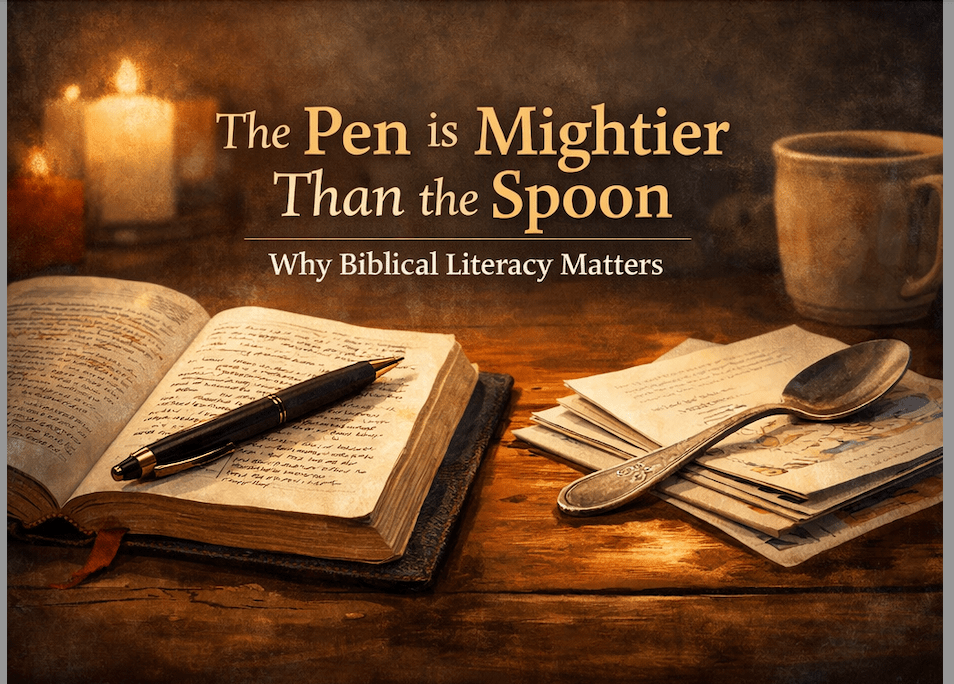
Why Biblical Literacy Matters
Most people have heard the phrase, “The pen is mightier than the sword.”
Words shape nations. Ideas outlive empires. Truth has power.
But when it comes to our spiritual lives, another phrase might be more fitting:
The pen is mightier than the spoon.
Not because feeding is bad—but because being spoon-fed was never meant to be permanent.
There is a kind of faith that grows strong through effort, attention, and ownership. And there is a kind of faith that remains shallow—not from rebellion, but from passivity. One is formed by engagement with Scripture. The other survives on secondhand truth.
The difference between them, I believe, is biblical literacy.
Spoon-Fed Faith and the Illusion of Growth
Spoon-feeding has its place. Infants need it. New believers often need it. There is nothing wrong with receiving teaching, listening to sermons, or learning from others.
The problem arises when receiving replaces engaging.
A spoon-fed faith expects others to do the work of reading, studying, wrestling, and discerning. It consumes Scripture pre-digested—filtered through sermons, devotionals, podcasts, or social media posts—without ever handling the text itself.
It feels nourishing. It feels safe. It even feels spiritual.
But over time, it produces believers who are familiar with biblical language yet unfamiliar with biblical meaning. Comfortable with Scripture stories, but unsteady with Scripture truth.
You can be well-fed and still malnourished.
And for many Christians, that’s exactly where their engagement with Scripture stops – right where it started. They recognize phrases. They recall stories. They know just enough to follow along—but not enough to explain, defend, or apply the Word with confidence.
Biblical literacy isn’t about whether you recognize the words.
It’s about whether you understand what they actually mean.
A Simple Diagnostic: What Do We Really Know?
Here’s a quick test—not to embarrass anyone, but to expose how easily assumptions replace Scripture.
True or False: In the Sermon on the Mount, Jesus says, “Cleanliness is next to godliness.”
False. That phrase comes from a sermon by John Wesley in 1778—not from Scripture.
Question: How many of each animal did Moses take onto the ark?
None. Moses wasn’t on the ark. Noah was.
Question: What color was the apple Adam and Eve ate—red or green?
The Bible never says it was an apple, much less what color it was. That detail comes entirely from art and tradition, not Scripture.
These examples are harmless on the surface—but they reveal something deeper. Many of us carry a mental version of the Bible shaped more by culture, memory, and repetition than by the text itself.
And when challenged, we often don’t know where to look for the answer.
That’s not a moral failure. But it is a discipleship gap.
The Danger of Secondhand Scripture
The greatest danger of biblical illiteracy isn’t ignorance—it’s unexamined confidence.
When believers rely primarily on:
- Sermon summaries
- Social media theology
- Familiar phrases without context
- Devotionals without meditation
They become vulnerable—to poor teaching, shallow faith, and distorted doctrine.
Getting all your theology from influencers is not biblical literacy.
Opening your Bible only when the preacher says, “Turn with me to…” is not biblical literacy.
Reading a paragraph from a devotional book each morning without allowing it to shape a single decision, attitude, or response throughout the day is not biblical literacy.
Biblically literate people read Scripture regularly, study it thoughtfully, reflect on it deeply, discuss it honestly, and apply it intentionally.
And then they build on what they learned yesterday by returning to it again tomorrow.
The Pen: Ownership, Attention, Effort
That’s why the image of the pen matters.
A pen represents engagement. It slows you down. It forces attention. It signals ownership.
When you take notes—whether in church, in personal study, or while reading Scripture—you are saying, “This matters enough to remember. This is worth wrestling with.”
The pen doesn’t replace the teacher.
It partners with the learner.
Biblical literacy grows when believers stop asking only, “What did this mean to them?” and begin asking, “What does this say? Why does it matter? How does it change me?”
God has always intended His Word to be handled, not merely heard.
Why This Matters More Than Ever
We live in a moment of unprecedented access to biblical content—and unprecedented confusion about biblical truth.
Information is abundant. Discernment is rare.
Without biblical literacy:
- Sincerity replaces accuracy
- Confidence replaces understanding
- Volume replaces depth
The church doesn’t suffer most from a lack of passion.
It suffers from a lack of formation.
And formation requires effort.
Looking Ahead: From Getting By to Growing Deep
In the book of Acts, we encounter believers who were sincere but incomplete, passionate but under-taught, faithful but missing something essential. We also meet ordinary men and women who helped others learn the way of God more accurately—and changed the course of the church in the process.
That’s where we’re headed next.
Biblical literacy is not about becoming experts.
It’s about becoming faithful stewards of truth.
So pick up the pen.
Next week, we’ll see what happens when believers move beyond spoon-fed faith—and begin to grow deep in the Word of God.
 Jacob Orr
Leave a comment