Words Matter.
Sarah and I will celebrate our 20th wedding anniversary this year. Nearly 20 years ago, I stood before all of our friends and family and took her hand, looked into her eyes, and said, “I take you to be my wife, to live together after God’s ordinance – in the holy estate of matrimony. I promise to love you, comfort you, honor and keep you, in sickness and in health, for richer, for poorer, for better, for worse, in sadness and in joy, to cherish and continually bestow upon you my heart’s deepest devotion, forsaking all others, keeping myself only unto you as long as we both shall live.
But what if I had said, “You’re alright; you’re not bad looking. I guess we’ll live together now.” Those words would hardly inspire a bride. That would have been far worse than “Your hands are so dry,” which is what I actually said when I first took her hand at the beginning of the ceremony. (Clearly, I’m not always eloquent.)
I was trying to pay her a compliment for how calm and collected she was in such a big moment, while my palms were sweaty. Clearly, the wrong words came out. Those words alone should have been enough to change her mind from marrying me. Thankfully, she didn’t stop the wedding right there.
But…words matter.
Suppose you find yourself in the most unfortunate and desperate situation where you are faced with dismantling a bomb or landing a plane in an emergency. You would need to be in contact with the professionals, the bomb squad or air traffic control, and they would need to walk you step by step through what to do to get out of that situation. You would want specific instructions or directions, not some vague statement like, “You’ll figure it out.” Even shampoo bottles usually say, “Lather, rinse and repeat if necessary.”
Words matter.
In Paul’s final words to his protege, Timothy, the instructions he leaves him are simple. They are simple, but they are clear.
Paul had one mission. And now that mission is being given to the charge ofTimothy.
2 Timothy 4:1-5 CSB
I solemnly charge you before God and Christ Jesus, who is going to judge the living and the dead, and because of his appearing and his kingdom: [2] Preach the word; be ready in season and out of season; correct, rebuke, and encourage with great patience and teaching. [3] For the time will come when people will not tolerate sound doctrine, but according to their own desires, will multiply teachers for themselves because they have an itch to hear what they want to hear. [4] They will turn away from hearing the truth and will turn aside to myths. [5] But as for you, exercise self-control in everything, endure hardship, do the work of an evangelist, fulfill your ministry.
The Greek word for “preach” in 2 Timothy 4:2 is κηρύσσω (kēryssō), which means to proclaim, announce, or herald a message, similar to a town crier or herald delivering a public announcement.
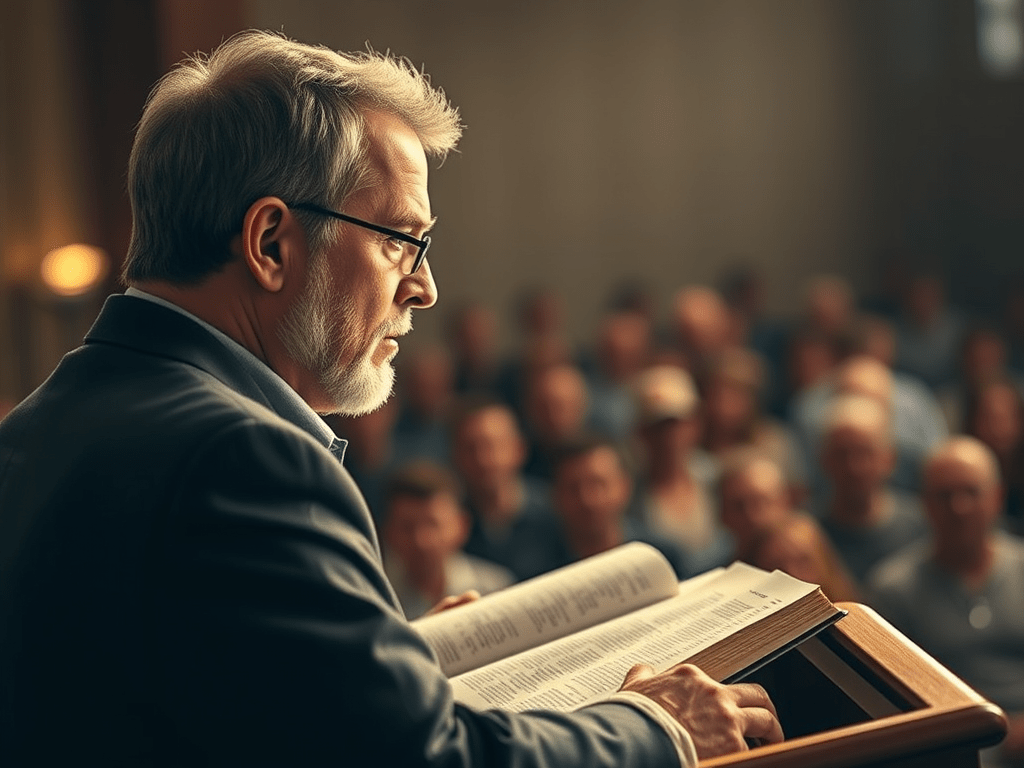
In verse two, the phrase “preach the word” stands out. While we often focus on the verb “preach” as the key action, it is not the most important word in this statement. Although it is indeed the calling of every minister, disciple, believer, and follower of Jesus to preach the Word, “preach” is just one action. The act of preaching does not affirm the calling or validate the preacher; instead, it is the message being preached that gives credibility to the preacher.
The word we preach is the living Word, which is active and breathed out by the living God. This Word corrects, rebukes, encourages, teaches, trains in righteousness, convicts, opens the eyes of the blind, captures the hearts of sinners, saves, and redeems. The power of the Word is far greater than any preaching alone could ever be. Therefore, let us remember to “preach the Word!” with a capital W.
What I preach is far more important than how I preach. I am not called to entertain or put on a show. I am not called to deliver a lecture for a class where you are being graded. The church pulpit is not a judge’s gavel or a rock star’s microphone stand. It is the place from which God has ordained me to preach the Word of the Almighty and the Gospel of Jesus Christ.
But that’s my role. What about you? You have a pulpit as well. You have a ministry, a calling, and a mission field. Teacher, your pulpit may be your classroom. Grandmother, your pulpit may be your kitchen table. Retiree, your pulpit may be your front porch, your favorite coffee spot, or the aisles of the local hardware and automotive stores. Wherever you are with people, you find yourself in a position to share God’s love and His Word.
Those around you may not be asking for it. They may not realize they are looking for it. They may not even want to hear it, or might outright reject it. But be self-controlled in everything, endure hardships, and do the work of an evangelist. Fulfill your ministry. Go and tell. Herald the good news. Preach the Word.
 Jacob Orr
Leave a comment